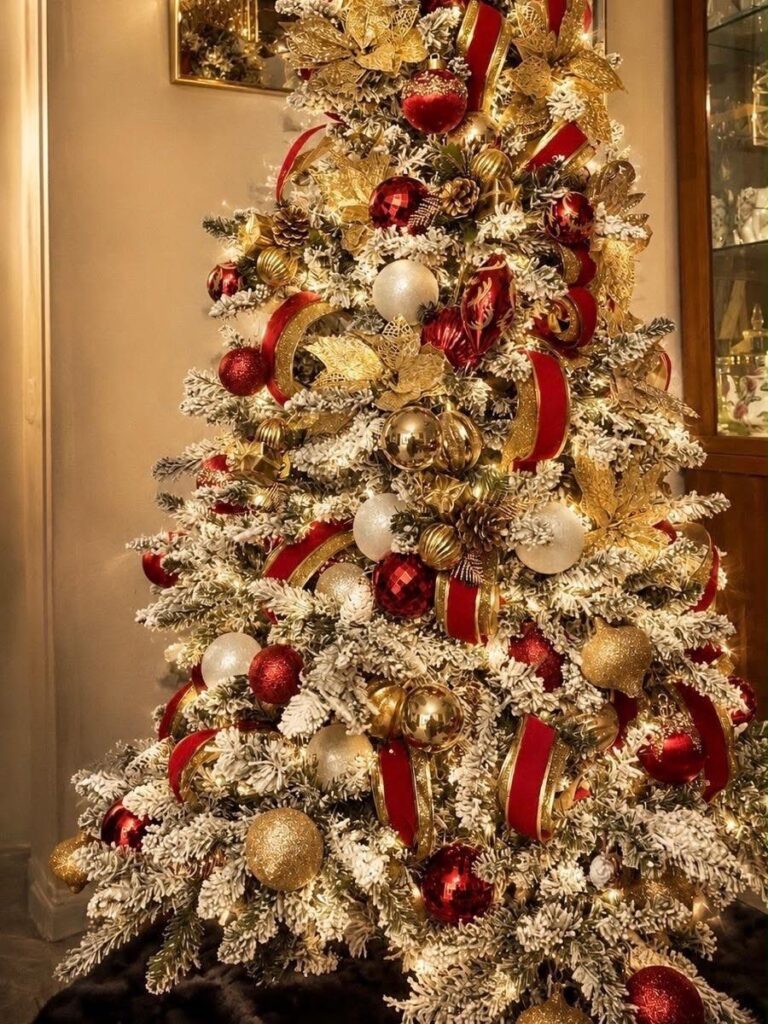
A red-white-gold Christmas tree can run from a box of candy canes bought after Halloween to a 7.5 ft flocked pre-lit centerpiece with hydrangea heads wired to the tips.
Flocking changes how every color reads: that same red velvet bow looks sharp against green needles and almost faded against white flocking, so plan the contrast you want before you shop.
Warm white bulbs matter more than anything else on the list; cool white shifts gold toward green and red toward purple.
[link-whisper-related-posts]1. Flocked Evergreen Tree
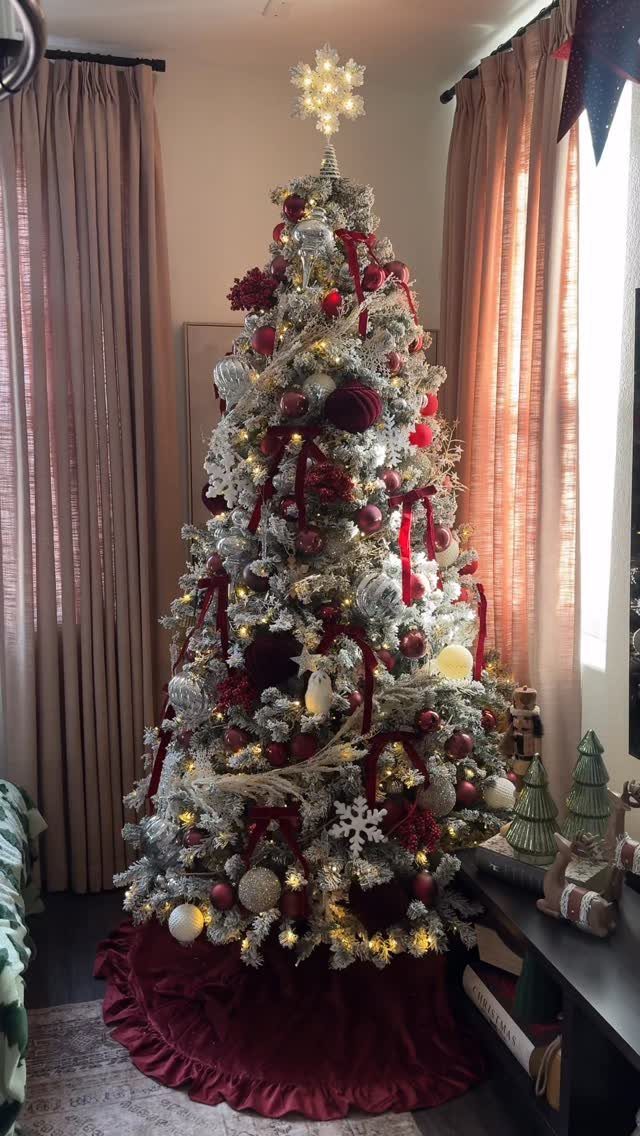
A flocked evergreen gives the red-white-gold palette its softest landing. The artificial snow catches light, so warm bulbs read candle-gold against the white instead of reading cold.
I start with a 7.5 ft pre-lit flocked tree, the Albany or similar, and cluster red toward the trunk where density hides gaps.
White snowflake ornaments read as texture from across the room, not individual pieces. Deep red ribbons wind through the branches at varying heights, low enough for kids to spot the ornaments but high enough to stay neat.
The star topper wants a wire anchor through two branches, not one. A single branch sags by New Year’s.

Snow Flocked Charm: Elevate your holiday decor with our 9ft snow flocked artificial Christmas pine tree; Its unique, snow-flocked look and 2094 adjustable branch tips provide the ideal canvas for your ornaments, creating a sophisticated and personalized festive touch. Rest assured that the flocked material is a safe cotton-based fabric

Golden Winter Glow: Pre-lit with 550 incandescent warm lights, the artificial Christmas tree creates a soft, inviting glow that transforms your space into a cozy and welcoming setting for family celebrations

Specifications: Color: Green & White; Type: Pre-lit Flocked Fir; Total Tip Count: 1278; Total Light Count: 550; Light Tone: Warm White; Materials: PVC, Powder-coated Steel; Assembled Dimensions: 55″ Dia. × 90″ H
2. Red Poinsettias and Gold Accents
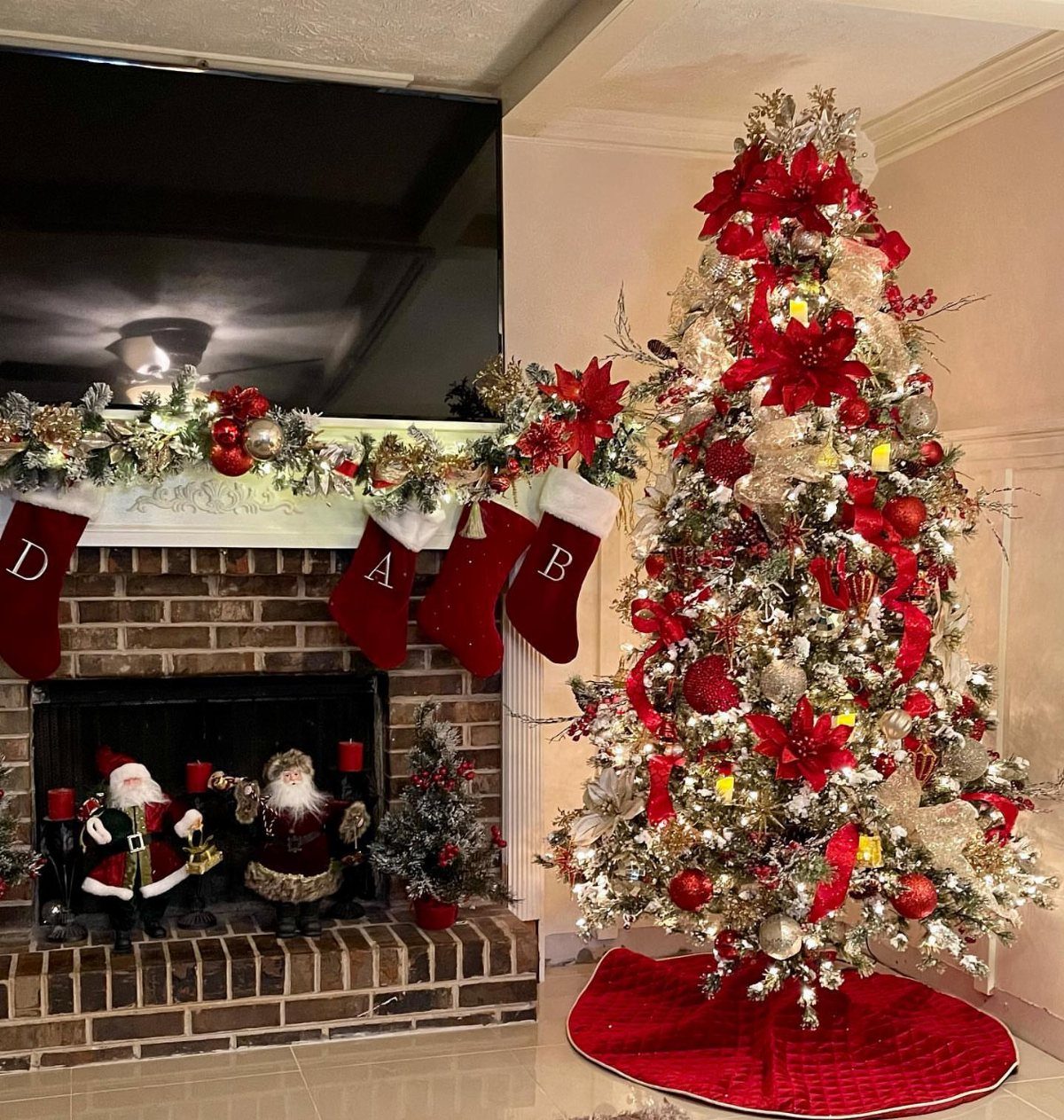
Fresh poinsettias drop bracts and stain floors. Faux ones solve that, and the oversized heads fill green-tree gaps fast.
Gold glitter branches from a craft store aisle, the wired kind, push deep into the center where their stiffness holds shape.
Poinsettias need their own light source or they go flat against the wall; the fireplace alone is not enough. Mixed with red and gold ball ornaments, the tree reads lush without reading expensive.
Warm lights matter here. Cool white turns the gold greenish and the red toward magenta.

🎄【Large Size】These large ornaments balls are 10cm/4". Pack of 9 Balls.Tree balls with light weight and won't weigh down your Christmas tree branches.

Value Pack: Our Christmas ornaments set has are packed in a 24 cm x 24 cm square box with a total of 44 Pcs Christmas baubles, which is particularly suitable for Christmas decorations.

🎅 【Red Christmas Ball Ornament Sets】 - Shatterproof red and gold Christmas tree balls size 60mm/2.36'', there are 6 different kinds of red and gold color shape, 30 balls in total. Dressing up your Christmas tree with our colorful ornaments.
3. Large Red and Gold Ornaments
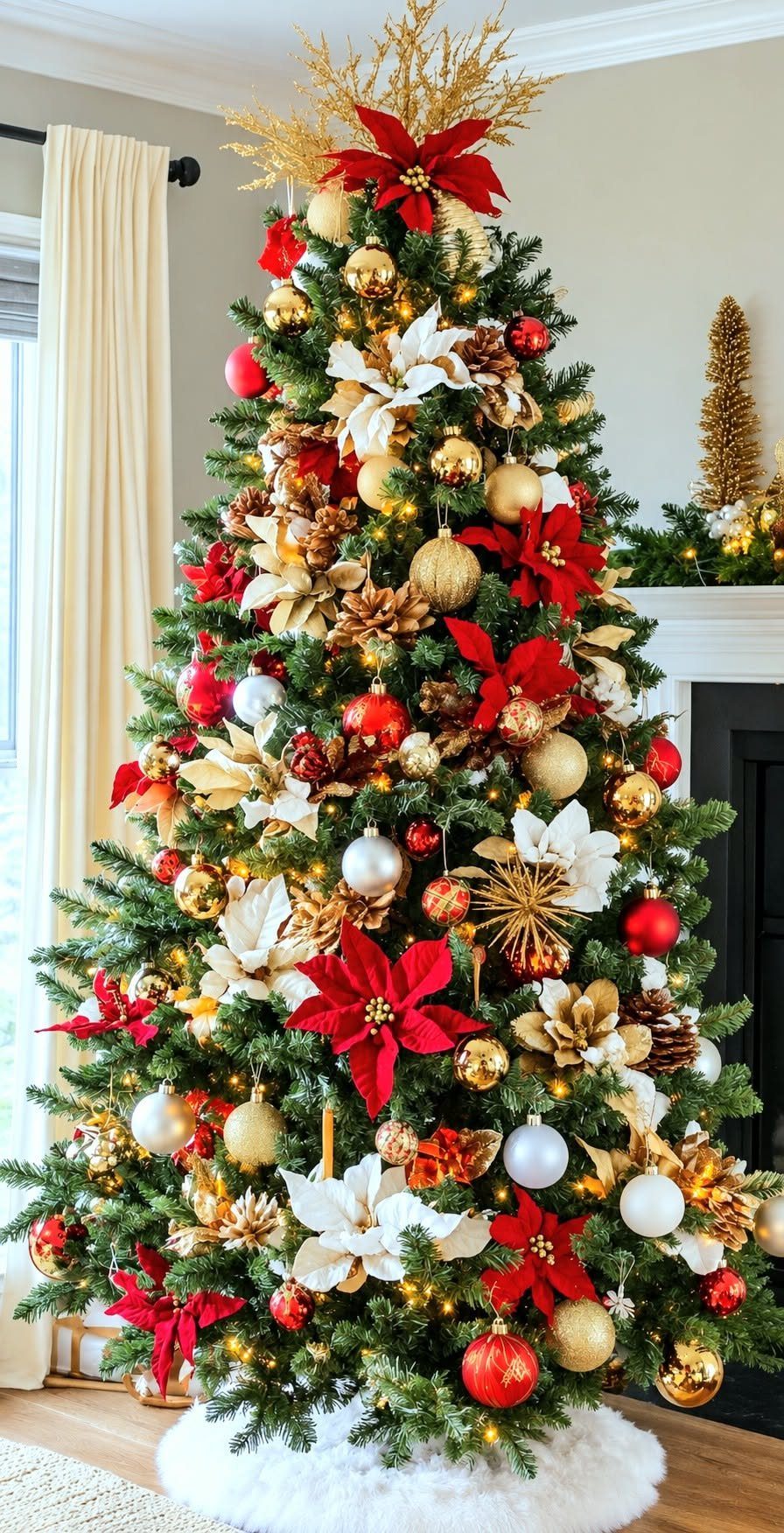
Scale is the whole trick. Small ornaments disappear on a full-size tree; these read from the doorway.
I buy red and gold baubles in the largest sizes I can find, limited counts, and place them where the branches can take the weight without drooping.
White faux poinsettias fill between, lighter than they look. A gold star topper needs a straight trunk section; I shim with corrugated cardboard if the top tilts.
Pinecones wired in pairs add brown that bridges the 3 main colors without adding a fourth.

ʚɞ Unique Material: These Christmas ribbon bows are made of velvet material.Giving you a soft and smooth touch, bring a warm festive atmosphere.

24-PIECE CHRISTMAS BOWS SET - Crafted from premium velvet ribbon, the bows add festive charm to your home and come packed in a sturdy box for easy storage or gifting.

ʚɞʚɞ Unique Material: These burgundy Christmas bows are made of velvet material.Giving you a soft and smooth touch, bring a warm festive atmosphere.
4. Gold Ribbon and Floral Accents
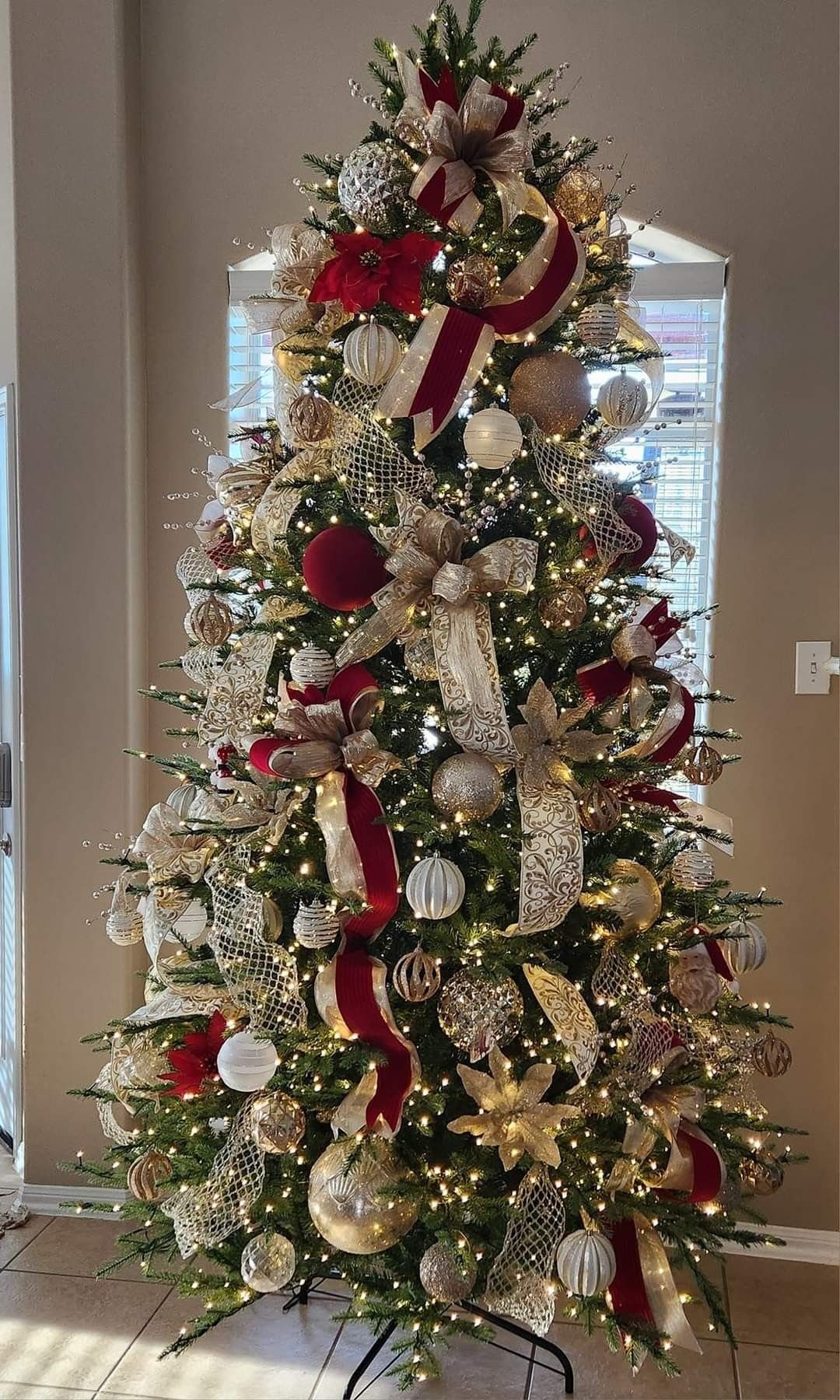
Gold ribbon behaves better than red. It reflects light, so a crimped or ruched run catches shadow and highlight both.
I cut floral picks from their stems and wire them to branches where the tree looks thin, not where it already reads full. Red ornaments cluster below eye level; gold and white float higher where the eye travels upward.
The ribbon spiral starts at the back, crosses to the front at uneven intervals, and never makes a complete circuit; full loops read as stripes from the side.
Warm white fairy lights, not cool. The red velvet bow version in some photos trades formality for softness.

Package Includes: the package contains 12 pcs glitter gold ornaments, each branch has 36 glitter berries; Add some to your christmas flower arrangements, ordinary wreaths, flower decorations, garlands or christmas trees to add a three-dimensional sense and add vitality

Package Contents: 48 miniature bottle brush trees in 5 different sizes, gold color. NOTE: Our Xmas tree is a SMALL size Christmas tree, Please carefully check the size and color of the tree in the picture before placing an order

Exquisite Craftsmanship: the package include 12 Christmas tree crystal picks, each crafted with meticulous; These accents add a noble atmosphere to your Christmas decorations, ensuring your home exudes elegance and charm throughout the festive season
5. Warm White Lights
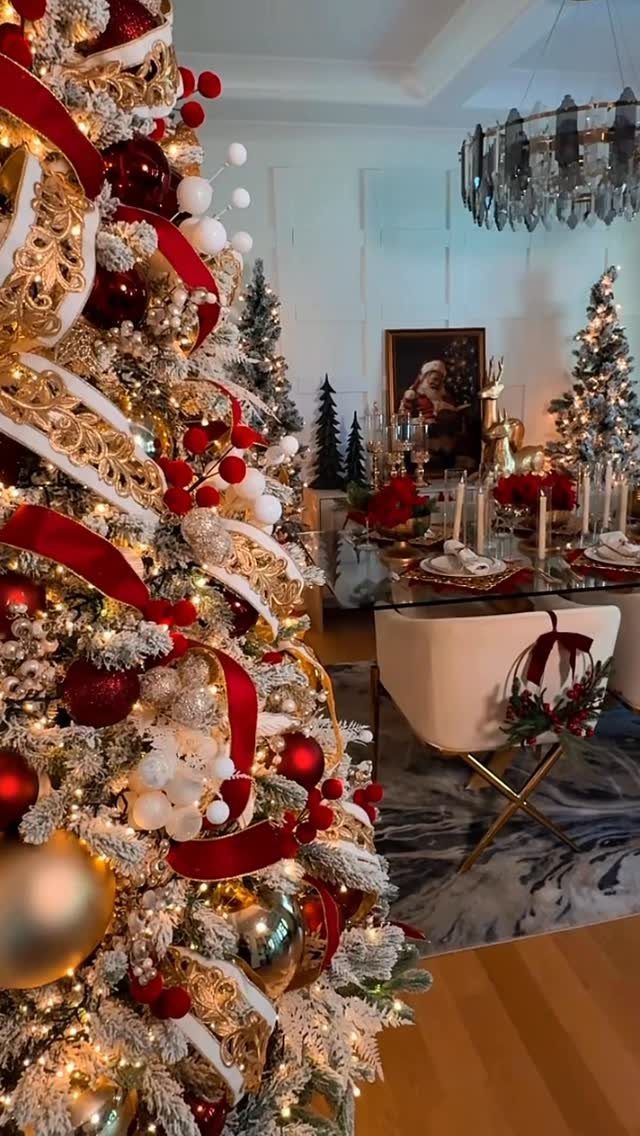
Warm white lights cost no more than cool white but change every color they touch. Red goes blood-orange and cozy; gold glows instead of glinting.
I use them as the base layer on any red-white-gold tree, flocked or green. The bulbs sit against the trunk, not the tips, so the light diffuses through needles and ornaments rather than spotting.
On a pre-lit tree, I check the factory color temperature before adding my own string; mixed temperatures read as a mistake.
In a dining room, dim the overhead fixture and let the tree carry the room.

Enough to Use and Share: package includes 50 pieces of Christmas tree picks, glitter and cute, each with a size of 30 x 10 cm/ 12 x 4 inches, sufficient quantity to meet your festive decoration needs, just like Christmas, New Years, and so on, can also applied in daily life to add delicate atmosphere; You can also share with your family and companions

Glitter Curly Cuttings: you will get 12 pcs gold Christmas glitter curly sprays, each one is 11.81 inches/ 30 cm long, the right size and large quantity packaging can meet your Christmas decoration needs

Generous Quantity: Each package includes 20 artificial champagne gold berries Christmas picks sprigs twigs with 12 champagne gold berries each for decorating Christmas trees at holiday or making art crafts
6. Red, White, and Gold Baubles
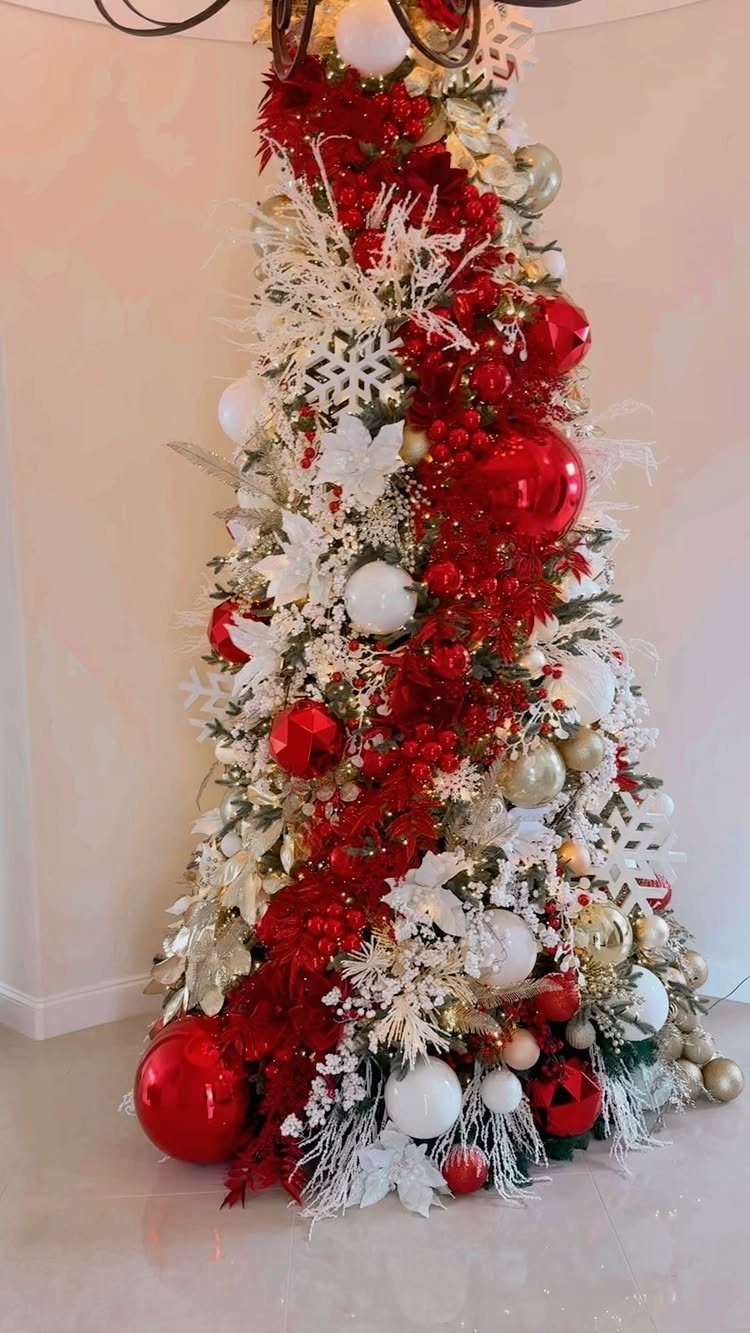
A mix of red, white, and gold baubles needs a fourth texture to avoid reading as dots on green.
Snowflake ornaments, the cut-metal or acrylic kind, break up the roundness and catch light flat.
I hang them on the outermost tips where they spin slowly and flash. Floral sprigs and berry clusters push deep, almost to the trunk, so the tree reads layered rather than surface-decorated.
The ratio I land on: half gold, quarter red, quarter white.
Too much red dominates; too much white goes sterile. I adjust after the first pass, standing at room distance.

ELEGANT SNOW-FLOCKED DESIGN: Experience a white Christmas as the vibrant green PVC pine needles are beautifully enhanced by a snow-flocked finish, transforming your home or office space into a winter wonderland!

FLOCKED CHRISTMAS TREE PRELIT - The lights have been manually wrapped around these tree branches before packaging, no need for you to wrap it again. Warm white lights are UL Listed. Just connect the male and female plugs in the upper and lower parts, and plug the AC plug at the bottom into a household socket, then the lights will on.

GENEROUS BRANCH COVERAGE – 544 PVC tips provide flexible shaping and ample places to hang favorite holiday decorations.
7. White Flowers and Metallic Leaves
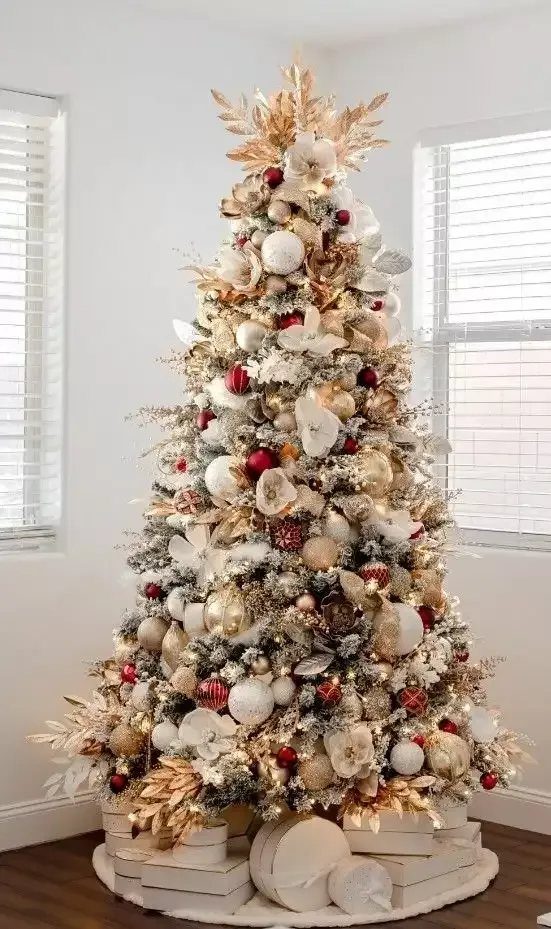
Large white flowers read as structure, not filler. Hydrangea heads or open roses, wired to the branch tips, hold their shape through January without water.
Metallic gold leaf picks push in behind them so the flowers lift forward.
Red baubles sit deeper, almost hidden, so the palette stays restrained from across the room. The white gift boxes below extend the same logic: white first, then a thin gold line, red only in the tag or ribbon end.
This version wants height. On a shorter tree the flowers overshoot the silhouette and read top-heavy.

Perfect Size - Expertly sized at 80mm (3.15 inches), this 12-pack is ideal for creating a full, professional-looking display. The ornaments are feather-light to prevent sagging branches and made from durable, shatterproof plastic for a worry-free environment around children and pets

【Velvet Luxe Palette】 Curated in red gold, warm christmas red, and velvet-textured hues (12ct, 2.36-inch). Blends classic opulence with modern tactility—perfect for mantels, Christmas trees, or tabletop centerpieces.

Made from environmental-friendly PVC material, and reusable
8. Red Velvet Bows
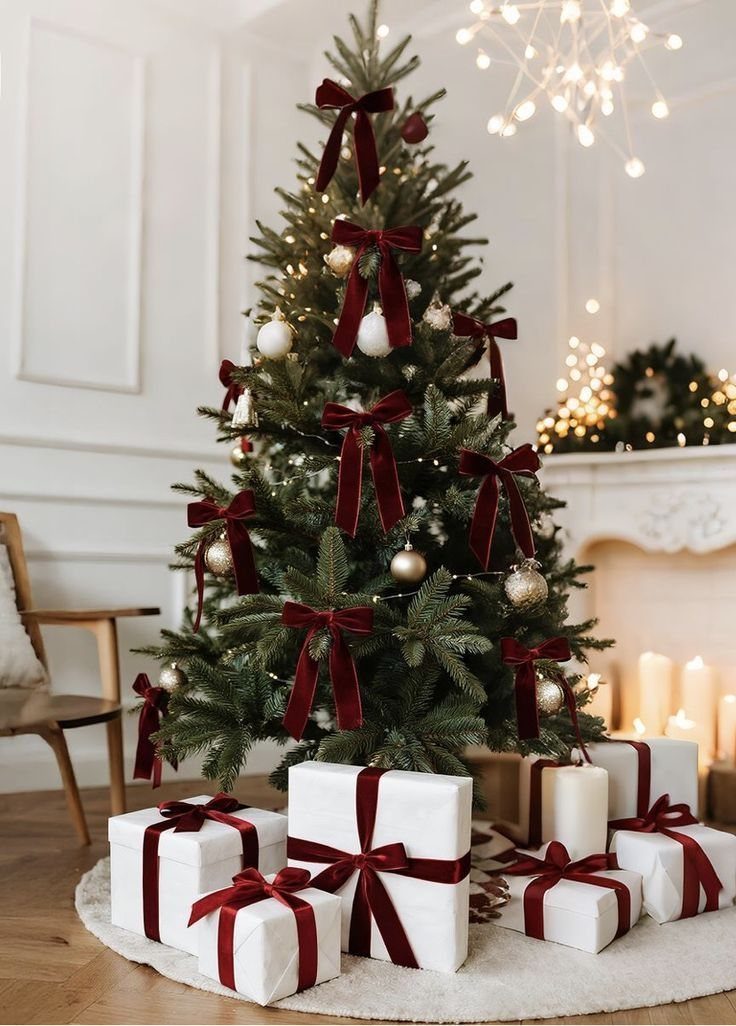
Red velvet bows tie the whole palette to something you can touch. The fabric absorbs light instead of reflecting it, so gold ornaments nearby need to carry the shine.
I make them from ribbon on a spool, not pre-tied: a two-loop bow with tails long enough to drape past the branch tips.
Wire through the knot, not the loops, or the velvet slides and the shape collapses. White wrapped boxes beneath carry the same red velvet ribbon up from the tree; the single red keeps the whole stack quiet instead of noisy.
The bows read formal on a green tree, softer against flocking. On pre-lit trees, check that the bulbs clear the fabric by an inch; velvet scorches.

Extra Long Ribbon Design: This oversized Christmas bow features two long, flowing ribbons that wrap, drape, or hang freely. The generous length offers versatile styling options, adding graceful movement and elegant charm to your tree and surrounding space.

Christmas Tree Topper: Giant bows are trending—and this oversized, eye-catching one makes your Christmas tree the star. If the product you receive varies from what is described, please reach out to us so we can make it right.

Christmas Bows Easy and Fun to Use: Just twist pretied Burgundy velvet bows and they’re hanging — quick and fun. Perfect for family moments, everyone can join in and enjoy turning the christmas tree into a warm holiday memory together
Mixing Colors and Textures
Shades of red read differently against each other than against green.
A burgundy velvet bow beside a bright red bauble makes both look intentional; 2 identical reds look like a matching set that failed. I keep one red warm and the other cool, or one matte and one shiny.
Gold has the same problem.
A metallic gold ball beside a glittered gold pick is 2 different metals fighting. I pair one high-shine gold with a flatter champagne or a deeper antique, and let the white carry the third temperature.
Textures work the same way. Smooth baubles need rough next to them: the cut surface of a snowflake, the fuzzy edge of flocking, the wired stiffness of a glitter branch.
2 smooth surfaces together disappear into each other. I place the roughest texture where the tree is fullest, the smoothest where the branches are sparse and the eye needs something to catch.

36 Pieces Christmas curly branches: you will receive 36 pieces of glitter branches, the product is suitable for DIY in various shapes you like, it is easy to bend and shape, and each piece can be DIY independently

Exquisite Craftsmanship: the package include 6 Christmas tree crystal picks, each crafted with meticulous; These accents add a noble atmosphere to your Christmas decorations, ensuring your home exudes elegance and charm throughout the festive season

Rich in Quantity: this package includes 30 pieces glitter Christmas tree pick, the size of each branch is approx. 35 x 7 cm/ 13.7 x 2.7 inch, very suitable for Christmas decorations
Budget-friendly Decorating Tips
The ribbon on a spool costs less per yard than pre-tied bows, and a two-loop bow takes thirty seconds once the hands remember the motion.
I buy one wide spool of gold and one of red velvet, enough for the tree and the gift stack below.
Faux poinsettias from the craft store aisle fill gaps faster than extra ornaments.
One stem bends to three positions and covers the space of three baubles. I remove the plastic leaves that come with the stem; they read cheap once you step close.
Candy canes are the cheapest red-and-white element on any tree, and they move to the kitchen jar when the season ends. I buy a box after Halloween when the markup is still low.
Warm white fairy lights on their own string let me replace a failed factory set on a pre-lit tree instead of replacing the whole tree. The add-on string costs a fraction and often outlasts the built-in one.

Material & Design Made of ABS pearl beads and flexible wire stems, these decorative bead picks are lightweight, bendable, and easy to arrange. Each 4mm bead is securely attached to create a delicate pearl-like accent for floral decorations

WHAT YOU GET: 12 gold artificial berry twig sprays, each about 19 inches long with about 35 berries per stem. Enough to fill a wreath, a tree or several centerpieces.

Size: 1-1/2 inch wide ribbon, continuous 10 yards length without splices, 1 roll per package
Layering Decorations
Depth on a tree comes from distance between the trunk and the outermost tip, not from crowding the surface. I start every layer at the center and work outward.
The first layer sits against the trunk: lights first, then the wired stems of glitter branches, the long tails of ribbon, the heavy baubles that need the sturdiest branch structure.
These disappear from the front view but catch light from the sides and cast shadow forward.
The middle layer holds the main ornaments, the poinsettias, the bows. I place them where the branch angle is nearly horizontal; too steep and they slide, too flat and they sit on top instead of settling in.
The outer layer is texture and flash: snowflakes on the tips where they turn, metallic leaf picks that lift past the silhouette, the thin ends of ribbon that escape the spiral. This layer moves, and movement reads as life.
Using Natural Elements
I wire them in pairs, one facing each direction, and push them deep enough that the wire disappears but the cone still catches light on its scales.
Floral picks work the same way.
The hydrangea or rose stem is too long for a tree branch; I cut it short and wire the head directly, or I leave a stub and wrap it to a branch with floral tape the same brown as the bark.
The flower faces outward at the tip, not upward where it collects dust.
Fresh greenery from the yard drops needles fast once it dries, so I only cut what I can use right away.
I use it only on the mantel or the table, never on the tree where the heat of the bulbs dries it faster.
A single branch of real holly, berries removed so they do not stain the carpet, wired to the gift stack below the tree gives the same effect without the mess.